Books That Redirected My Grief Journey
As a former writer and producer, I sometimes surprise people when I tell them that Wendy and I didn’t even have a television for 11 years. Yes, we streamed media, but we read. A lot. Thus, when she died and I was searching for answers, I went to the refuge we had always sought in our lives: the bookstore. Throughout my career, I’ve been a researcher who has always felt I could get to the bottom of things by digging as deep as I could. What I discovered was that grief doesn’t really have a “bottom.” However, I gained a vast amount of information by reading the wisdom others have written.
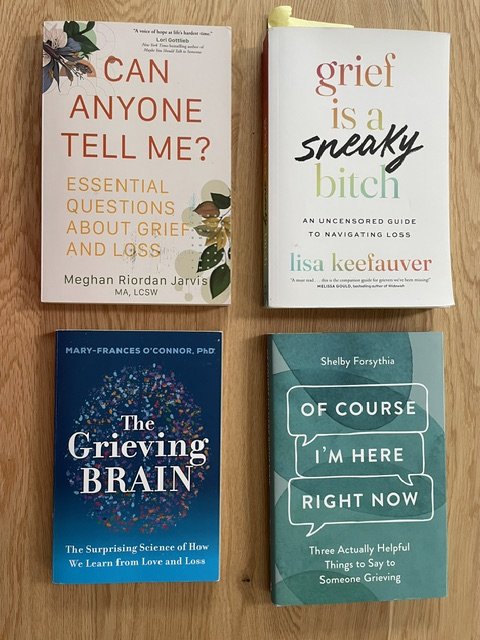
Now, as a certified grief educator, I am often asked to provide recommendations. Since I’ve been asked this quite often, I thought I’d blog to expand upon the list I offer up because there were four real gamechangers during my journey. Because I read almost every book with a highlighter in hand, as I explain these books, I’ll point out the portions I marked up in yellow because they gave me permission, provided exactly what I needed, and helped lift me up and move forward.
Can Anyone Tell Me?: Essential Questions about Grief and Loss
Author: Meghan Riordan Jarvis, MA, LCSW
Before purchasing this book, I found Meghan’s podcast, “Grief is My Side Hustle,” and listened to episode after episode. The one thing I stress to someone who is newly grieving and asks me about a book: you may not be ready for a book. Look, reading takes time and comprehension. Neither is truly possible during those first months. You’ve got legal issues and all the practical loose ends that need to be tied up after a loved one dies. You can’t sit quietly and read. Plus, in that grief brain fog, it’s hard to absorb all the great parts. However, you’ll eventually get there and when you do, find this book.
Meghan helps explain why you’re feeling unfocused, why you can’t sleep, what the grief timeline entails, and when to seek help. This book explained why I felt as if I was walking around with an old-time diving helmet on and feeling lightheaded. I discovered that the rushed-time constraints society established didn’t apply to my experience and it provided permission to let that be OK. I understood why I felt guilty, afraid, angry, and sad all at once.
Most importantly, this book took a deep dive to examine what happened to all my relationships and explained what I presumed was a unique experience. This was a vital first step to my healing.
Immediately after Wendy died, I was left alone. I don’t mean figuratively—I mean that literally. Everyone who was in our home during those last moments left the minute the mortuary took her body away. Family members and friends let my calls go to voicemail.
As the months passed, colleagues said unthinkable words, including, “We were Wendy’s friends, not yours, and we’ve moved on.” Friends we had together admitted they didn’t “do grief well” and stopped talking to me.
These actions are crushing to someone going through profound grief. They add to the trauma and become secondary loss. One of the reasons I became a grief educator was to raise awareness on this topic. It’s rarely discussed, and I presumed that people would provide me support in the way I’d seen historically through my own family. When my grandfather died, I remember there were so many people in my grandparent’s house that the kids were told to go down to the basement. Sitting alone after Wendy’s death, I thought I was doing grief “wrong” and that something was askew with the way I was processing everything.
Meghan’s words helped me understand the bare-bones fact: I was grieving the loss of my wife, someone I loved so much that we stood before a judge and legally vowed to remain together for the rest of our days. But I was left behind when Wendy’s days ended. People forget to tell you that “till death do part us” means one of you will go first—and the other will be left to navigate this confusing world as a single person again.
Highlighted text:
“You do not need to explain or prove your grief to anyone at any time.”
“Once you become a griever, you remain one.”
“Grief is not a problem, but our culture equates feeling bad with somehow failing.”
“You do not owe anyone grace or understanding when you are the one overwhelmed with pain, nor is it your job to teach people how best to approach you.”
“Grievers feel lost because they have lost.”
The Grieving Brain: The Surprising Science of How We Learn from Love and Loss
Author: Mary-Frances O’Connor, PhD
I first learned about Dr. O’Connor’s work when she appeared as a guest on Meghan’s podcast. I rushed to get her book the minute I knew it was out there. It was published in February 2023, just months after Wendy’s death and the very month I arrived in Kentucky to care for her mother. Because Wendy was an only child, she asked me on her deathbed to promise I’d look after Corinne. Within four months, I sold most of our belongings and our condo in California, packed the remaining things in a truck and drove across the country. On my first day of that trek, my mother-in-law phoned me just as I hit the Arizona state line and told me that she, too, had been diagnosed with Stage 4 cancer.
I’d just watched my beloved wife suffer through eight months and was walking right back into Cancerpalooza. The news hit like a punch to the chest. I settled into an apartment in Louisville and the first day of a new job was the first day my mother-in-law started chemo. She died 16 months later. During that time, Wendy’s oldest friend also passed away.
Dr. O’Connor’s words were everything I needed to hear at the time. If a lightbulb could have appeared above my head as happens in cartoons, it would have glowed brightly. For the first time, I understood that grief wasn’t just about emotions. It affects your brain and your body, too, making grief a physical as well as emotional experience.
This book uncovers the science of the brain—how it works and why it changes during times of grief. The question changes from “What are the stages of grief?” to “What is the brain actually trying to learn after someone dies?” That is a significant shift in how grief is understood. I began to recognize grief as a learning process, and that changed absolutely everything because I, like so many other grievers, thought I was crazy. As Dr. O’Connor points out: “You’re not crazy, you’re grieving.” That one sentence truly saved me.
In the book, she explains that when that person dies, the intellectual knowledge that they are dead and the brain's deeply learned expectation that they are still part of our world don't immediately match. So, I could know that Wendy had died and, at the same time, automatically expect to tell her something when I walked in the door, or expect that she might telephone me from work, or expect that I’d run into her at the coffee shop.
None of that would happen, of course. But it wasn’t denial. As Dr. O’Connor explains, the brain is a prediction machine that operates on the knowledge it’s taken in. When someone dies, its predictions are no longer accurate, and it has to update. That can take a long time. And no two people are the same; after all, no two people heal on the same timeline from any physical injury. It can be similar, but not exact. That’s why grief is so unique.
Meeting Dr. O’Connor at Meghan’s first Grieftastic Book Fair was indescribable. It was that celebrity moment wrapped in so much gratitude for her work and her words. I highlighted so many passages in her book that I probably should have dipped it in yellow ink, but some of the most profound takeaways are here.
Highlighted text:
“Searching for our loved ones after they have died is a very common experience. Holding and smelling their things in order to feel close to them is also very common and does not mean a person is crazy (despite what Hollywood might suggest).”
“Grieving people often describe having a lost part of themselves, as if they have a phantom limb… We might think it is simply a metaphor to say that we have lost a part of ourselves when a loved one dies, but as we have seen, representations of our loved ones are coded in our neurons… Consequently, the process of grieving is not just about psychological or metaphorical change. Grieving requires neural rewiring as well.”
“Why would we believe that our loved ones will return, if we know that that's not true? We can find answers to this paradox in the neural systems of our brains, systems that produce different aspects of knowledge and deliver them to our consciousness.”
“As our mind wanders, we continue to get reminders from the brain to call or text our loved ones, but now these reminders conflict with reality...You are not losing your mind; you are just in the middle of a learning curve.”
Grief Is a Sneaky Bitch: An Uncensored Guide to Navigating Loss
Author: Lisa Keefauver, MSW
You want to get some odd glances and unusual questions from strangers? Read Lisa’s book poolside as I did after moving back to Southern California. Yes, the title grabbed me but but it was the insight that stuck.
Keefauver provides a cultural, emotional, and deeply human language for living with grief. By pointing out that many of the stories we've inherited, including the “five stages,” “closure,” “moving on,” “time heals,” “everything happens for a reason,” can actually make grieving people feel worse. That’s why this book clicked for me. I knew what I was going through and it wasn’t like anything I’d seen anyone experience. I was searching the social mores, customs, and beliefs, only to feel like I was the odd one out. That’s a horrible feeling to have to carry while you’re also grieving your most beloved person.
Additionally, as the title alludes to, Keefauver’s use of profanity and humor throughout gave me permission to say what polite grief language wouldn’t let me say. And here, I thought, was someone else out there who truly got it because the profanity wasn’t peppered in just to be edgy. It is, I feel, an appropriate rejection of sanitized grief. When you’re going through the worst days of your life, you don’t want to settle for “darn it!” Some things are “F-ed” up and they should be recognized that way.
Highlighted text:
“While there are varying definitions of trauma, I prefer this one by world renowned physician and author Dr. Gabor Maté: ‘Trauma is not what happens to you, it's what happens inside of you because of what happened to you. Trauma is that scarring that makes you less flexible, more rigid, less feeling and more defended.’”
“It seems the only worthy goal for holidays or anniversaries is joy. Anything less is a sign that you're a Scrooge. Bah humbug. To be honest, holidays and anniversaries are not that different than the rest of the year, as we live in a culture of toxic positivity, only covered in an extra layer of decorations and lights. I'm here to remind you that joy doesn't have to be your goal in these seasons.”
“Homesickness is a quality of grief that is too often ignored. For many of us, the losses we experienced were the people who made us feel at home, no matter where we were.”
“Toxic positivity is a shallow response to someone's display of pain, offering false reassurance instead of responding with empathy and compassion. The reason people run this sham is because of their own discomfort with sitting with negative or difficult emotions.”
“Though it's likely no solace to you, others’ aversion to your pain has everything to do with them and nothing to do with you. Many of us haven't learned how to be with our own suffering so we freak out and shut the door when we witness pain in others.”
Of Course I'm Here Right Now: Three Actually Helpful Things to Say to Someone Grieving
Author: Shelby Forsythia
After Wendy died, people made a number of super-unhelpful comments and offered unsolicited advice. Some were real humdingers that still ring in my head all these years later, including:
“I can never speak to you again. It’s too hard without Wendy. She’ll forever live in my memory.”
“If we asked God ‘why’ right now, we wouldn’t be satisfied with the answer.”
“You are young; you can find someone else.”
“She’s one of our angels now.”
Every platitude, no matter the intention behind them, landed harshly. All I wanted them to understand was how much pain I was in, and I desperately needed their support.
When these words were first spoken, I had such anger because I was so disappointed. In time, I’ve come to understand that, if I were to be honest, I was not a great grief supporter either. I tried. I sent cards, flowers, and money to pay for expenses. But say the right thing? No. I didn’t have a guidebook. So, I forgive all those people because in 2022, they didn’t have a guidebook either.
Thankfully, Shelby has penned one. I now recommend it everywhere and to everyone. As a society, we need to know how to support each other when the worst thing happens. Researchers at Center for Complicated Grief at Columbia University estimate each death leaves about five people bereaved. In the U.S., 1.2 million people died from COVID. Thus, statistically speaking, there are approximately 5 million people grieving those deaths. That doesn’t even bring into consideration deaths by cancer, car accidents, or tragedies from natural disasters or events like 9/11. That could be millions more.
Grief is the natural response to any loss. We cannot heal from this pain and properly move forward unless we address it and support each other when needed. When we do, having the right words means everything. Her book is specifically designed for friends, family members, coworkers, clients, and professionals who want to support someone grieving but don't know how to respond. She even addresses specific circumstances that may arise so supporters may recognize what phrase is appropriate when.
And the genius is that the three phrases she recommends address three different fears grieving people commonly tell themselves:
“I'm crazy.”
“I'm alone.”
“My life will be like this forever.”
No one must become a grief counselor to know exactly what to say. When someone is hurting, it’s human instinct to try and make the hurt stop. But you can’t make grief go away, nor should you try. Instead, supporters can help someone from being alone with that horrible pain. It’s not necessary to “cheer them up,” just acknowledge the weight they are carrying and let them know you are there.
Honestly, during those first days, I didn’t want anyone to say anything. I just yearned for someone to sit next to me on the couch, hold my hand, or put their arm around me.
Highlighted text:
“Instead of teaching one another these life skills on a widespread, mass-accessible scale, we’re left to pick them up by osmosis or via the school of hard knocks as we carve our individual paths through the labyrinth of life.”
“Words can undo us. But words can also ground and orient us and can help us know where we’re going.”
“Society would like us to believe that our role as comforters is to make it all better, to magically produce the right combination of words that frees a grieving person from the shackles of pain and sends them dancing down the hallway and out toward a better, happier life. But what if, when a griever is spiraling inside the story of ‘I’m crazy,’ we gently remind them through ‘of course’ that they are not crazy; they are a human inside of a chaotic experience, and that there is someone in their corner who validates and comprehends their story. We may not be the person experiencing the tragedy, but we can sit or stand beside a grieving person and say, ‘Hey! I saw it too.’”
Find more books I recommend here: https://www.letmylossbeyourgain.com/recommended-books
Get your tickets for the next Grieftastic Book Fair.
Has this helped you? Don’t miss future blog posts; sign up and get them delivered directly to your email box.
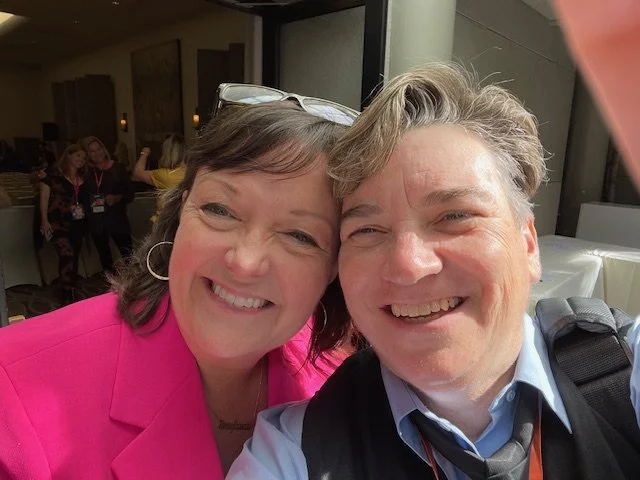
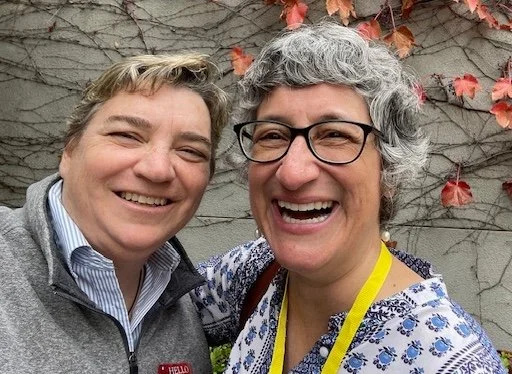
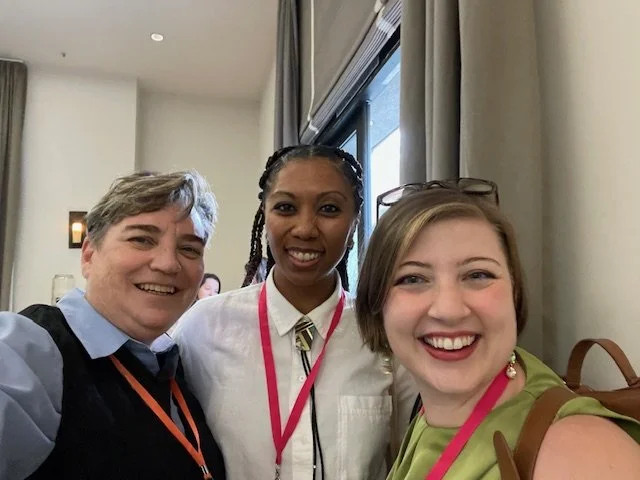
It’s been a great joy to meet my grief heroes: Meghan Riordan Jarvis, Dr. Mary-Frances O’Connor, and Shelby Forsythia (R – with Dr. Julie Shaw between us).