
Apologies for the Abandoned Cart
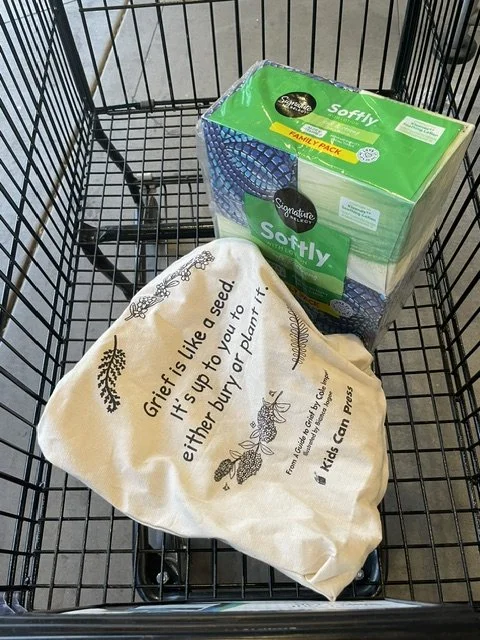
Sometimes, buying the tissues may be all you can muster.
There are plenty of things people expect to be difficult after someone they love dies.
Birthdays. Anniversaries. Holidays. The first Christmas. The first time you hear their favoritesong. Seeing their side of the bed empty.
But the grocery store?
Yeah, that one can catch you completely off guard. And it’s another one of those “why doesn’t anyone tell you?” moments. In keeping with my mission to have you learn from my loss, I’m going to clue you in: YOU ARE NOT CRAZY, YOU ARE GRIEVING and the grocery store absolutely is a trigger.
Let me explain.
The first time it happened to me was two weeks after Wendy died. I walked into the grocery store, froze in the doorway, and walked back to the car. My friend Deb was with me, and when people in the parking lot saw me sobbing and shot concerned glances, Deb would reply, “What? What?” and have them move along with a nothing-to-see-here wave of her arm.
So, I publicly apologize to Trader Joe’s, Kroger, Lazy Acres, and Gelson’s for all the carts I left abandoned in the aisles, certain I could make that shopping trip the one time I’d get through my task without incident (but it did not happen).
Maybe you were standing in the produce aisle, reaching for the avocados you always bought together, then suddenly felt your throat tighten.
Or you turned down the cereal aisle and realized you no longer need to buy those flakes and strawberry cereal your spouse loved.
Maybe you automatically reached for two of something that now you will only need one of. Or you glanced over to see that cheese spread you’ll never have to buy again because your spouse loved it and you couldn’t stand it.
Or just maybe there isn’t one obvious thing that sets you off at all.
Perhaps you simply find yourself crying next to the frozen vegetables and quickly eye the exit because you don’t want to become a scene.
You Are Not Doing Grief Wrong
There are very good reasons why something as mundane as grocery shopping can become a minefield of memories. The grocery store is filled with your former life, and one of the cruelest things about grief is that the world doesn’t stop when your most beloved departs this planet.
It just keeps spinning.
And even if your appetite lessens, you still need to eat. Your pet still needs food. The laundry still needs to be done.
And eventually, you have to buy groceries.
Grocery shopping is “normal,” and it represents ordinary life at a time when your world has shifted and your life no longer feels ordinary.
Best-selling author, psychotherapist, podcaster, and grief advocate Megan Devine has devoted an entire piece to the grocery store as a place of grief, describing it as an emotionally difficult environment because it is simultaneously necessary, mundane, and intensely social.
People who are grieving conjure memories of the person they lost while seeing other people going about life mindlessly, or (worse) encountering someone you know who is unsure about what to say or may unexpectedly ask how you are doing.
The grocery store doesn’t give you the luxury of staying inside your grief. It asks you to make decisions about eggs and bread while another part of you is still trying to comprehend the fact that the person you shared those breakfasts with is no longer here, and it sucks.
Food Isn’t Just Food
Grief aside, food carries memories. Mac and cheese makes you recall youthful moments, or a chocolate shake may make you remember a first date. Buttery popcorn can evoke thoughts of great movies at the theater. Strawberry ice cream may be associated with every summer you spent at the lake.
When your most beloved is no longer here to enjoy the snacks in the pantry, whip up the curry recipe they knew by heart, or create the Thanksgiving dish that was always their job to make, those sensory experiences can unexpectedly activate memories.
The Mayo Clinic notes that reminders of a loved one can arise through sensory cues such as sights, sounds, and smells, sometimes unexpectedly. Additionally, it’s about what food represents. As noted above, your summer, your holidays, or moments of your relationship. And your body may remember before your brain catches up.
Meghan Riordan Jarvis, MA, LCSW, whose work focuses on the intersection of grief and trauma, emphasizes the importance of recognizing that we grieve with our bodies. That concept is especially relevant in a grocery store. Your brain may understand that you’re simply standing in aisle seven, but your body may recognize something else entirely.
The smell of a particular shampoo.
The sight of a favorite brand.
The song playing overhead. (Argh, that Muzak!)
The route you always took through the store.
These seemingly tiny experiences can momentarily reconnect you to the life you shared before their death, only to remind you painfully of what you’ve lost.
And suddenly, grief hits you right there and then because you’re confronting that absence.
That’s the part where grief can blindside you, and it’s why many grievers equate it with waves. Anyone who has spent a minute at the ocean knows you don’t turn your back on the water; it can unexpectedly slam you down and take you under.
Thus, something you don’t see (that absence) can be worse than what you can see (like a holiday or anniversary).
So Now What?
We live in an age of apps and delivery services. I never found them particularly practical for shopping for one, but others who have suffered a loss have mentioned that taking advantage of modern-day conveniences was helpful for them.
But if you are brave enough to venture out, remember this: a grief trigger doesn’t mean you’ve gone backwards. It doesn’t mean you’re not moving forward. And it certainly doesn’t mean you aren’t healing.
Lisa Keefauver, MSW, encourages grievers to name what is difficult, expect the unexpected, and give themselves compassion rather than judging the way grief appears.
One day, you may walk through the grocery store without thinking twice. The next week, you may burst into tears over a jar of pasta sauce. Both experiences can be part of grief. And both are OK.
You don’t necessarily have to avoid the grocery store forever.
In fact, extensive avoidance of reminders can sometimes make grief more difficult over time. The Association for Behavioral and Cognitive Therapies notes that avoiding painful feelings and reminders may provide short-term relief but can interfere with adjustment.
Instead, find ways to make grocery shopping more manageable.
Give yourself permission to leave. (If you’re overwhelmed, you can leave your cart.)
Sit in your car. Cry. Take a few breaths. Go home. Try again another day.
You might also consider shopping when the store is less busy, like early mornings or late evenings.
Wear headphones to create your own zone.
Make a short list and only grab essentials.
Take a friend with you for support.
Remember that there is no moral achievement attached to pushing a cart through an emotional minefield. Finding ways to cope is part of the grief journey and your healing.
Be gentle with yourself, and if you find that this task is keeping you “stuck,” or you just can’t go back to the grocery store ever, seek professional help. There’s nothing to be embarrassed about when you ask for assistance getting through the hardest parts of your grief.
Additional Insight
Megan Devine: Personal stories and expert perspectives on why grocery shopping can be particularly difficult after a loss.
https://speakinggrief.org/get-better-at-grief/grieving/the-grocery-store
https://speakinggrief.org/get-better-at-grief/supporting-grief/grief-and-groceries
Shelby Forsythia: “I love going to the grocery store said no griever ever” https://www.facebook.com/watch/?v=1585477600266643
Books by Meghan Riordan Jarvis and Lisa Keefauver
Has this helped you? Don’t miss future blog posts; sign up here and get them delivered directly to your email box.