
It’s the Little Things in Life
People often assume a wave of grief only slams you on the big days, like birthdays, anniversaries, and holidays. Because those moments are expected to sting, we often anticipate and prepare for them. Many grievers take steps toward self-care, perhaps by walking in nature or gathering with friends. Others set aside time to celebrate their person, leaving an empty chair at the holiday meal or taking time for a gravesite visit.
Truth is, you can never turn your back on the ocean because big waves can come at any time. I’ve found this to be one of the most confusing parts of grief. Before Wendy died, I never heard anyone discuss these moments that often arrive without warning, and in the most seemingly unusual places.
Paperwork that hurts
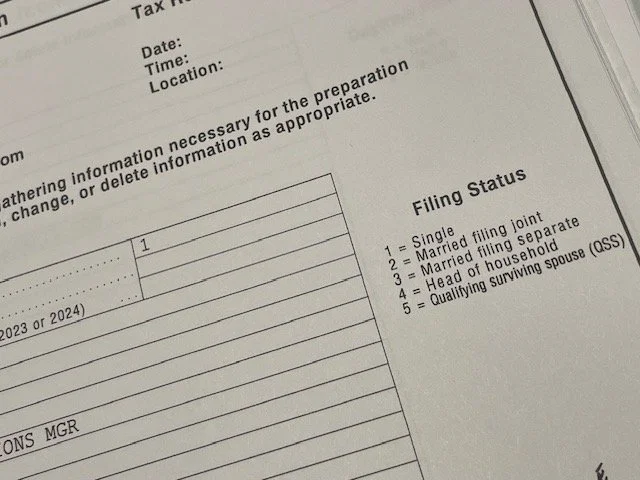
Tax filing is never anyone’s favorite task, but three years after Wendy’s death, I still feel the gut punch when I must note my status. That simple switch from “married filing jointly” to “single” is like a giant government stamp that declares your loss official. There’s also the financial reality that the change can also increase tax rates—a phenomenon sometimes called the “widow’s penalty.”
My financial advisor will also verify that every time I sit on the other side of her desk and discuss my bank accounts, it can be a trying experience. There’s one account I still nickname “Wendy’s savings” because it started out that way, and I can’t bear to change it.
I have to admit, reading Dr. Mary-Frances O’Connor’s book, “The Grieving Brain,” was a game-changer for me. When these moments were happening, I thought I was crazy. She explained the science behind how grief makes concentration and decision-making harder. In acute grief, our mental resources are redirected toward coping with emotional pain, leaving less cognitive capacity for complex tasks. This means that the moment you are least equipped to deal with complicated paperwork is exactly when it arrives.
Abandoned carts
Who knew that the grocery store would feel like an emotional minefield? The very first time it happened was a couple of weeks after Wendy died. I was at Trader Joe’s and saw her favorite cereal (she liked the Flakes and Strawberries). It was at eye level, and if I could have crumbled into a ball right there in the aisle, I would have. Instead, I just bolted out of the store, leaving the cart behind. A friend who had gone with me had to quickly follow me back to the car, where I let loose and wept.
I was grateful as she navigated curious onlookers for me, countering with, “What? What?” as she urged them away. (Thank you, Deb!)
That wasn’t the only time or place. There were so many moments when I’d instinctively reach for her favorite treats, like the wine cheese spread or peppermint ice cream she enjoyed. These were go-to items that were always on my mental list. Then the moment came when I’d remember she wasn’t at home to eat them. Instead of embarrassingly bursting into tears, I’d walk right out of the store.
My friend Glenda admitted this practice wasn’t unique. She was shopping at Northgate Market when the combination of Mexican food scents and seeing mothers and daughters together tugged at her. When the song “Amor Eterno” started playing in the overhead speakers — it’s a song about the passing of the singer’s mother — it reminded her of the moment they’d played the song at her mother’s internment. Tears at the checkout were inevitable for her.
Grief counselors sometimes refer to these unexpected emotional waves as “grief ambushes.” The grocery store is such a difficult terrain because food, in particular, carries powerful emotional memory. According to research referenced by the National Institutes of Health, sensory cues like taste and smell are deeply tied to emotional memory, which is why something as simple as grocery shopping can trigger a flood of grief.
And those triggers can be as simple as the foods your loved one enjoyed, but the shopping experience reminds you of routine decisions that are no longer there and meals that are now transformed because cooking for one is so different.
Identifying the hurt
Certainly, it can feel embarrassing to break down over something that seems incredibly trivial. Who cries about cereal? But going back to Dr. O’Connor’s science and research by psychologists, they say the reason is simple: grief lives inside routine. Daily life is where relationships actually happen. For example, you may not remember every holiday dinner, but you remember who cooked daily breakfasts, how you navigated cooking together in a tiny kitchen space, or who did the dishes at night.
When those quiet routines disappear, and you encounter a practice after your loved one’s death, your brain instantly notices the absence. The tax form isn’t just paperwork. The grocery store isn’t just a store anymore. They’re reminders of a life that once existed.
It’s vital to remember thatgrief triggers are not a sign you’re “doing grief wrong.” They are a common part of the grieving process, and there are ways to make them easier to navigate:
Expect them. One of the hardest things about triggers is how surprising they feel. Simply knowing they exist in these seemingly mundane places and times can reduce the shock. Also recognize that these waves can happen even years after the loss.
Make everyday tasks easier. If grocery shopping is overwhelming, consider shopping at a different location. Since you know the map of your favorite store in your head, going somewhere new helps rewire your brain. Of course, there’s always the option of skipping the store and ordering online. I did that for a while, but the downside is you don’t get to choose just two bananas; you get the whole bunch. That, in turn, became a trigger because it reminded me how alone I was.
Ask for help. Friends often want to help but don’t know how. This is how! Practical support can be invaluable during grief. You shouldn’t feel guilty tapping someone for assistance. It’s not weakness, it’s a sign of strength and courage.There’s also no shame in going to financial experts because they can help with tax and estate decisions when your grief clouds decision-making.
Have a coping plan. Simple grounding techniques actually help. At times, I’ve utilized the5-4-3-2-1 method, which involves noticing things you can see, feel, hear, smell, and taste. This practice helps calm the nervous system. Also, there’s always the option of walking away, taking a breath, and returning when you can. (Again, back to the abandoned carts being OK.)
Be gentle with yourself. The most important thing to remember is that grief doesn’t follow a schedule. Our society delivers some skewed messages about grief, and that’s why so many people who experience profound grief start to believe they have lost their minds or they are broken. It’s not true. It is absolutely commonplace to feel fine all morning and then lose it in the frozen food aisle when you shop in the afternoon.That doesn’t mean you’re going backward.It means you loved someone deeply, and the world is still full of reminders of that love.
Ordinary moments can feel like emotional earthquakes, but I like to keep author Penelope Ward’s quote in mind: “Life is made up of little moments that don't seem that important at the time, but in retrospect they're what get you to where you are.”
Don’t miss future blog posts; sign up here and get them delivered directly to your email box.