
Recognizing National Colorectal Cancer Awareness Month the Best Way I Know How
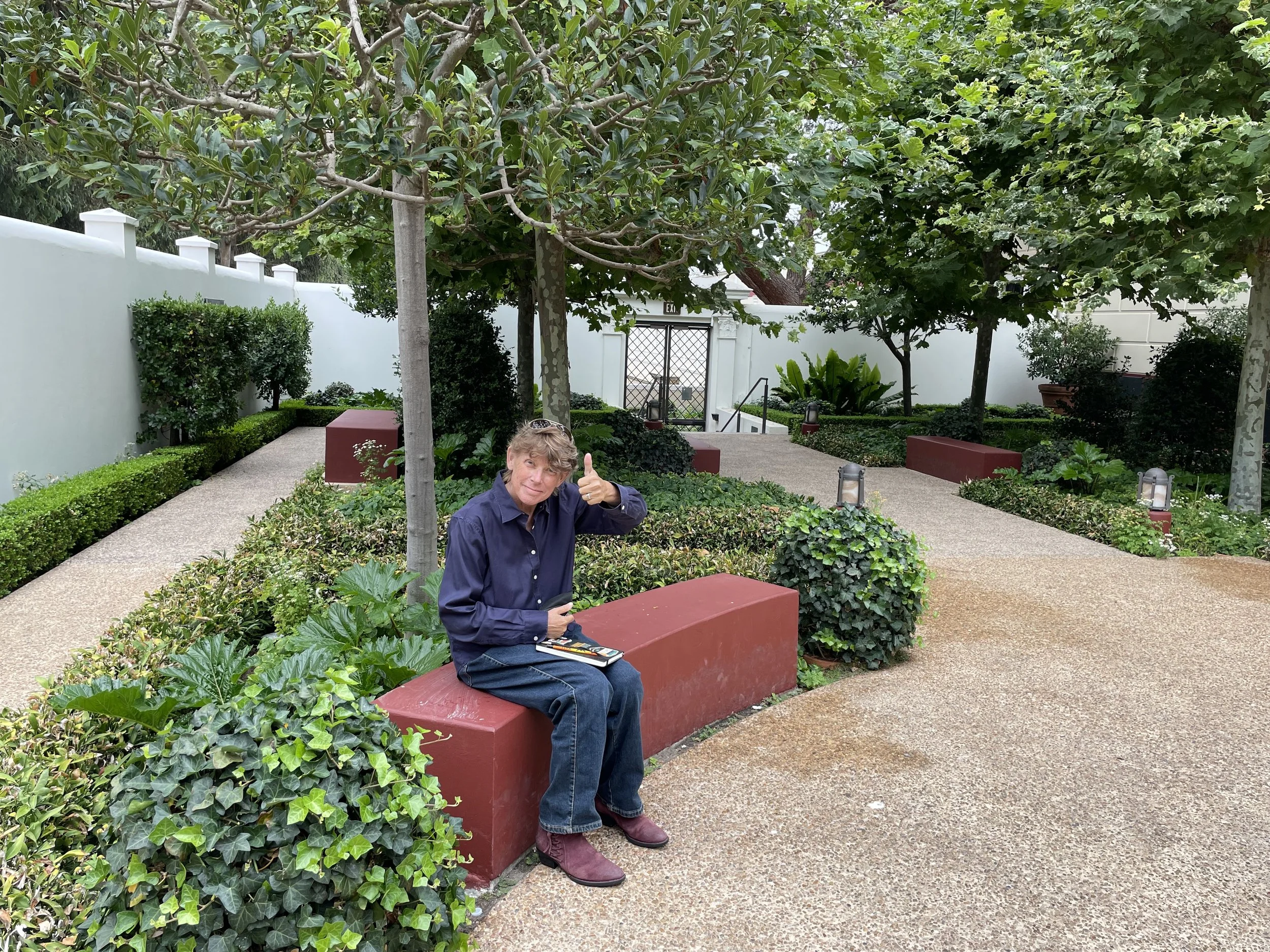
September 2022, just three weeks before she died. We went to the Getty Villa so she could look at ancient art and take notes for class.
If you’re an NCAA basketball fan like I am, you know March is widely considered one of the best—if not the best—months for the sport. What you might not know is that March is also National Colorectal Cancer Awareness Month.
Say what?
Yes, a whole month dedicated to promoting screenings, detection and cancer prevention. So, you know what I had to do? Have a colonoscopy. To be fair, I didn’t really have it planned this way. A bout with food poisoning, more than a week of bowel distress, and colitis that prompted an ER visit, meant seeing a G.I. specialist sooner rather than later.
I was gently reminded by a colleague that talking about this important procedure might be “too personal” to share. A dear friend said, “You’re not like anyone I know.” When I asked why, she said, “You talk about things like colonoscopies.”
In the same way I advocate for open conversations about grief and loss, I’m just as adamant about speaking plainly about the health concerns that can lead to that loss. Silence helps no one. With an estimated 158,850 new colorectal cancer cases and 55,230 deaths projected in the United States in 2026 alone, it remains the second-leading cause of cancer death in the country.
And yet, people still lower their voices when the subject turns to colonoscopies—as if it’s too icky to discuss. But let’s be honest: dying of colon cancer is far more unpleasant. Journalist Katie Couric understood that reality after her husband, Jay Monahan, died of the disease in 1998 at just 42. In the years that followed, more than 1.2 million additional lives were lost to colorectal cancer before my wife, Wendy, was diagnosed with Stage 4 in 2022. Couric didn’t just talk about the trauma of becoming a young widow—she talked openly about colon cancer and even televised her own colonoscopy (including the prep) to raise awareness. When I bring up a topic others find awkward, I figure I’m in very good company.
Couric has said that Monahan showed few symptoms beyond extreme fatigue, which he attributed to constant cross-country travel. Wendy noticed she was unusually tired too, but she blamed menopause and the stress of work. In hindsight, those quiet explanations can be dangerous. Sometimes the signs are subtle—and the conversations we avoid are the very ones that might save a life.
We had a conversation, but it’s still one I recall with great regret. It was October 2020, and Southern California had started to allow small gatherings as COVID waned. Wendy’s mom had a stepsister who lived near us, and we made a careful agreement: if both households isolated, we could meet briefly at their condo. One evening we shared snacks, played board games, and—like everyone that year—talked about health.
The conversation turned to colonoscopies. Wendy’s aunt had one after pandemic delays lifted. She spoke about polyps that were caught early and the pleasant “twilight” sedation used during the procedure. Wendy, however, had always been wary of medicine. Her father’s long struggle with esophageal cancer and other health issues had left her skeptical of treatments and medications that, in her words, “never helped.”
She also had a habit of finding those unsettling medical stories like the rare surgical sponge left behind after someone had been stitched up. Besides, we believed we were doing everything right. We ate mostly vegetarian and organic food, shopped at the farmers’ market, walked our dogs four or five miles most days, and Wendy cycled at least 50 miles a week. Other than some achy knees, we thought we were healthy.
With hospitals overwhelmed by COVID, it seemed reasonable at the time to wait instead of booking a colonoscopy even though at age 54, we had been advised to have the procedure. I still remember sitting at her aunt’s dining table, placing my hand on Wendy’s thigh in quiet support as she gently argued her case for postponing the test. Everything else seemed more urgent.
Then came her diagnosis. An oncologist stood at the foot of Wendy’s hospital bed and told us they didn’t believe the cancer had started in her liver, which was riddled with 70 percent cancer. They suspected it began in her colon and had spread. She would need a colonoscopy for the doctor to know. As the nurses discussed the prep procedure with Wendy, I kept uttering under my breath, "Shit, shit, shit, shit, shit!" in anger, fear, and regret.
Months after Wendy’s death, I started thinking about conversations we easily have with children because they are often fascinated with what our bodies do. There is a classic potty-training book authored by Tarō Gom entitled, Everybody Poops. We’d seen the book cover on an adult-sized T-shirt in Los Angeles’ Little Tokyo. This anti-stigma approach should be a reminder to everyone older than two years of age that passing stool is what every creature on this planet does. Does it smell bad? Well, yes, of course. It's bacteria that must be expelled from our bodies. But nothing natural should be considered disgusting, and it should not bring shame.
I know Wendy was likely embarrassed about whatever was happening because there is stigma surrounding what goes on in our gut and what comes out. Whether she knew it might be cancer or not, I'll never truly know. But clearly, her bowel habits had changed, and she never said a word. Because she never had a colonoscopy, I’ll also never know whether catching it early would have saved her life or not.
It's been said that grieving people are often left with more questions than answers after losing their most beloved. I still wonder why didn’t she tell me what was going on. Was she embarrassed? And why did she have to die?
The mission of this website—and of all my work—is to help others learn from my mistakes: to say the words that often go unspoken, to have the difficult conversations, and to normalize topics that should be part of everyday life. I appreciate when someone tells me they admire that I’m willing to say what others won’t. But the truth is, I wish it weren’t unusual. I wish speaking openly about the things that matter most was simply what everyone did, especially when it comes to a potentially life-saving test like a colonoscopy. It’s not a bad word. Just say it.
Watch Couric’s colonoscopy here. Note that a lot has changed in the 26 years since this aired on NBC. For example, the prep, which causes dread for so many people, is not one giant dose. Instead, the standard four-liter “jug” you used to have to gulp down in one night has been replaced by lower-volume liquids of approximately two liters or less over two days. My advice: get a good book and soft toilet tissue. You’ll do just fine. Really.
Don’t miss future blog posts; sign up here and get them delivered directly to your email box.