
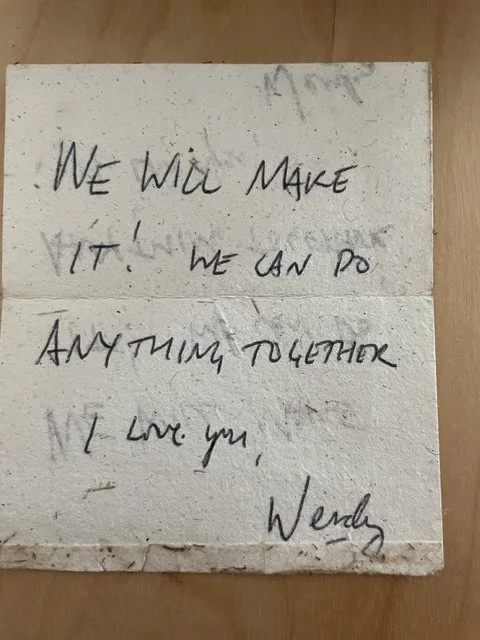
For a long time, I carried this note in my wallet and thought I could only move forward as a team.
In grief groups, when you discuss the death of your spouse, they often label the love of your life “your person.” The thing is, “your person” was not singular. You were a team.
Losing a spouse means losing a companion, a confidant, a best friend, and often the person with whom you built your identity, routines, and vision for the future.
What was once teamwork can become challenging when it suddenly falls on you.
When the life you knew suddenly feels unrecognizable, even the simplest decisions can become overwhelming. It’s not just the day-to-day; it's the future you imagined that is no longer possible the way you both planned.
Many people are left wondering not only who they are without “their person,” but how to live without them. Data even shows that surviving spouses face a 66% higher chance of death within the first three months after losing a partner—this well-documented phenomenon known as the widowhood effect.
This is where resilience comes in.
It isn't about “being strong,” bouncing back, or finding a silver lining in likely the biggest tragedy of your life.
It’s not even about “getting over your loss.” You move forward one tiny step at a time. Eating the giant elephant you’ve been served, one small bite at a time.
Resilience is learning to live with what has happened while finding ways to remain connected to life in the singular.
Understanding Resilience Through Grief
People often talk about resilience as the ability to overcome adversity. But grief challenges that definition. How do you “overcome” the death of someone you loved when loss and grief forever change you?
Perhaps a better way to understand resilience in this circumstance is the ability to adapt to a life you never wanted. It’s not easy; I’ll give you that. But I’ve learned that adaptation can take many forms. In those early days of grief, resilience can look like getting out of bed and taking a shower. Consider those days a huge win!
Resilience might also look like:
Learning to manage finances
Making decisions about your home, children, or pets
Laughing for the first time
Traveling somewhere new
Getting through the holidays
Celebrating an anniversary
And sometimes, resilience simply means giving yourself permission to feel whatever you feel, or allowing yourself to cry (even in the middle of the supermarket aisle) because you miss your person.
Grief does not follow a straight line. Neither does healing. You may feel capable and confident one day, ready to move forward. The very next day, you may be overwhelmed by an unexpected memory. That doesn’t mean you’re not resilient. It does mean you’ve lost your progress. It’s simply grief.
I learned that square one was the day Wendy died. I slowly moved forward a step or two, often falling back. But you never really go back to square one. That was your absolute worst day ever.
Now, it’s about making little progress in another direction.
You Can Be Resilient and Still Be Heartbroken
Therapists will tell you, as they have told me, that two things can be true at once.
Because you can be sad and still find strength.
You can be vulnerable and still resilient.
You can move forward independently and still desperately miss having your person beside you.
You can find joy, even if you feel guilty about it.
You don't have to choose between honoring your grief and embracing life. In fact, allowing yourself to experience the full range of emotions associated with loss can be an important part of adapting to your new reality. Suppressing sadness to appear strong doesn't make you resilient. Neither does pretending you're doing better than you are.
I promise you, when you choose to feel your grief and give yourself permission to have difficult days. You will find your way forward more easily than if you ignore it and push it under the rug. If you do that, one day you’ll trip over it in one way or another.
And remember: you don't need to turn every painful experience into a lesson, find meaning in every coincidence, or demonstrate personal growth to justify your healing.
Your grief deserves compassion, not a performance.
Rebuilding Your Identity After Losing a Spouse
So, now what? Right?
Rebuilding your identity doesn't mean abandoning the person you lost. It means discovering how to carry your shared history into a life that is now yours to navigate. And good news: there is no right or wrong way to preserve your connection while creating a life of your own.
You might:
Rediscover an old interest
Pursue a long-delayed goal
Explore something your spouse never particularly enjoyed
Become more intentional about how you spend your time
Decide that certain traditions can be abandoned
Meet new people or even a new love interest
You might even discover that talking openly about death, grief, and the challenges of widowhood permits others to do the same. Just sayin’.
Here’s the important point: none of these things have to happen immediately. You don’t move forward until you are ready. Don’t judge yourself. Don’t look at another person who is also facing the loss of their beloved. You do you. And when you are ready, you are ready. Not before. Period. End of sentence.
One of the most important things to understand about resilience after losing a spouse is that moving forward doesn't mean moving on. You don't have to stop missing your person to experience happiness or find joy again.
Love doesn't disappear when someone dies. Your relationship changes, but that person's significance and the experiences you shared remain part of your story.
You'll have new experiences you wish you could share with them. There may even be moments when you feel conflicted about enjoying life without them.
That's okay.
But getting up off the canvas after the horrible blow has felled you, that is one way of honoring the life you shared. That’s resilience, even when life looks nothing like you expected.
You aren't starting over from nothing. You're starting from everything you learned, experienced, and shared with the person you loved and who loved you enough to get you to where you are right now.
10 Actionable Steps for Coping and Moving Forward After Losing a Spouse
Need additional guidance? Consider these practical steps. Again, you don't need to do all of them, and you certainly don't need to do them at once.
1. Give yourself permission to grieve. You don’t have to measure against anyone else. Ever.
2. Establish a manageable daily routine. In the beginning, start with the basics. Get dressed, take a shower, eat something nourishing, or take a walk. Structure can provide a sense of stability when so much of your world feels uncertain.
3. Stay connected to other people. Grief is isolating. Loneliness can become particularly difficult. Make an effort to maintain friendships, connect with family, or find a support group. Consider grief counseling if you need additional support. You don't have to navigate this alone, so don’t.
4. Find ways to maintain a connection with your spouse. Keep photographs visible, celebrate meaningful dates, cook a favorite meal, or continue a practice you shared. Find rituals that allow you to honor your relationship, not because you are stuck but because you’re learning to move forward.
5. Make one independent decision at a time. Whether it's handling a household responsibility, planning a vacation, or making a financial decision, recognize each small step. When you do, it can help rebuild confidence.
6. Reconnect with something you enjoy. Rediscovering yourself does not mean letting go of your life with your love. It means recognizing that life is now yours to live in a way that’s comfortable for you.
7. Practice saying yes to new experiences. You don't have to be ready for everything. But recognize the times you want to shut down and say “no.” Then, occasionally challenge yourself to accept an invitation, visit somewhere new, or attend an event on your own.
8. Set boundaries with people who don't understand your grief. You’ll have people who think you should “be better by now.” Others may avoid mentioning your spouse because they don't know what to say. Let people know what you need. Yes, you’ll lose some friends and other relationships may fall away. That’s okay. You’re going through a major life transition. Sometimes those are too difficult for others to understand or share with you. Recognize what helps you.
9. Set small goals for your future. It’s too hard to imagine the rest of your life in one swoop. Look only at small sections. Identify one thing you'd like to accomplish this week, this month, or this year. Goals can restore a sense of direction as you plot a path.
10. Celebrate the wins. Notice the moments when you surprise yourself. No matter how tiny, recognize how you handled a difficult situation, laughed unexpectedly, made a new friend, or experienced a day when you didn’t cry. Don’t judge. Don’t let guilt creep in. Celebrate the win for yourself.
Being the surviving spouse isn’t what we expect when our vows contain “until death do part us.” Losing your person changes the trajectory of your life without question. But you are still here. And now, while it challenges your sense of security, identity, belonging, and future, you can still find meaning. And happiness. You can acknowledge the magnitude of your loss while recognizing that there is still life to be lived. That’s what resilience looks like.
Don’t miss future blog posts; sign up here and get them delivered directly to your email box.
Want to talk about this more? Want me to speak to your group or organization? Reach out!