
Why Anniversaries in Grief Can Feel So Overwhelming
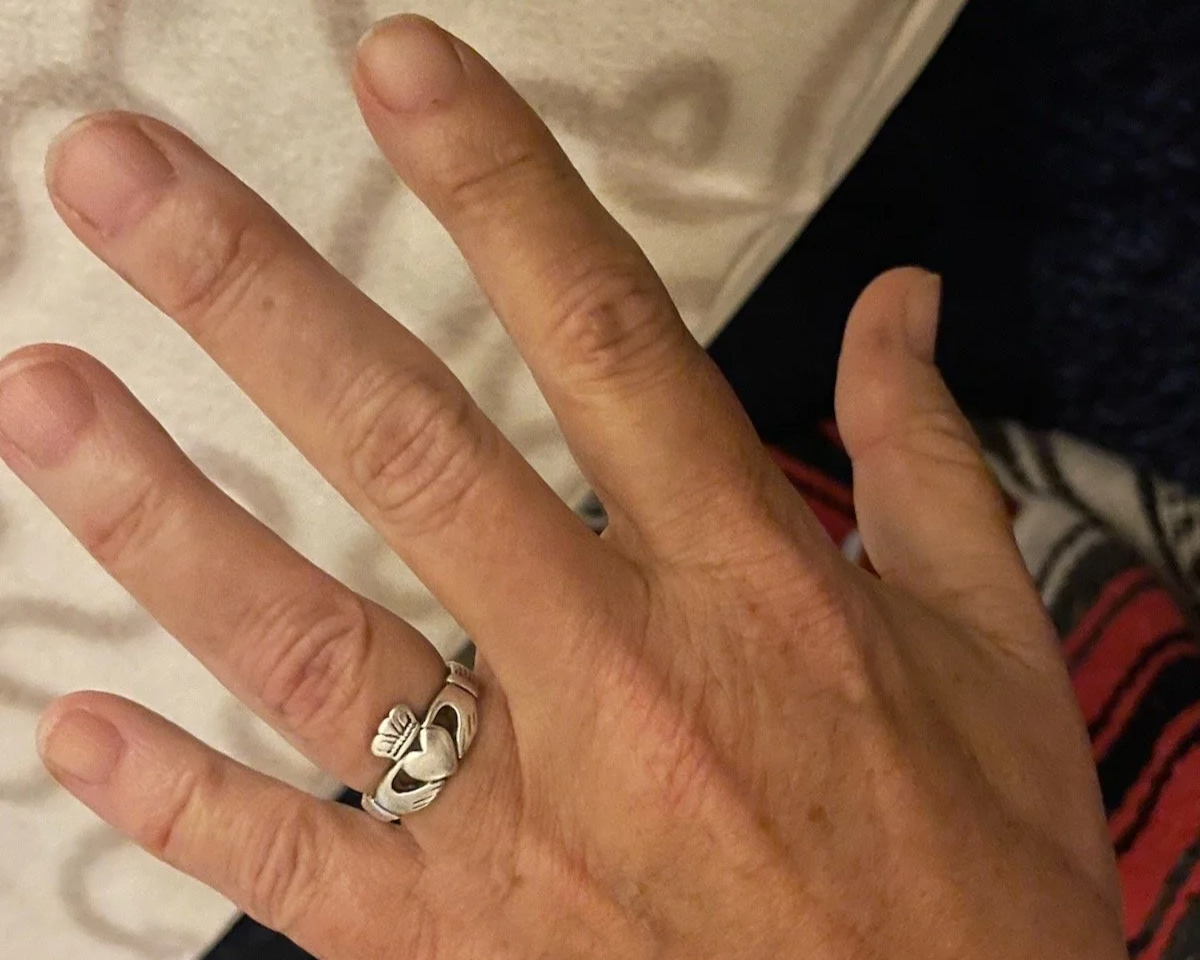
We didn’t have photos from our wedding day. Instead, I have to treasure this photo of Wendy’s hand with the ring I gave her. I took it in March 2022, because the chemo was starting to discolor her skin and nails, and we wanted to document it for the oncologist.
December 2011 wasn’t usually cold by Chicago standards, but those final weeks of the year were a sloppy snow and rain mess that iced the air so much that you could feel it down to your bones. Wendy and I had been together for three months. We were living in her condo in Oak Park when our first New Year's Eve together rolled around.
What do you do when you're with one of the most introverted girls ever? Stay in, watch DVDs, and listen to the radio. Surrounded by stacks of movies and British mysteries from the Oak Park library, we tucked into the warmest room in the condo—the tiny guest room with the radiator humming beside the bed. Even our dog Dolly claimed her spot, hunkering down on a blanket adjacent to the old hissing heater.
Somewhere between DVDs, I found myself on the edge of saying something life changing. I didn’t plan it. I wasn’t particularly smooth about it either. I circled the idea, hesitated, and tried to gesture my way through what I couldn’t quite say out loud.
Wendy, of course, wouldn’t let me off that easily.
“Just say it,” she insisted, laughing.
And eventually, I did. I asked if we could get legally married.
Her answer came quickly, joyfully—and with just a little bit of teasing about how long it took me to get the words out.
We were so grateful to be living in Cook County, Illinois. It was one of the few places in the country at the time where it was possible to enter into a domestic partner union because same-sex marriage wasn’t yet legal across the country. Getting married seemed the most vital demonstration of our deep love and commitment to each other.
Taking the steps to tie the knot proved to be more complicated because Dr. Koenig was a busy gal. After consulting her calendar, March 30 was the first day of her spring break. That is how we decided on our wedding date: it fit into Wendy’s highly complex schedule. Honestly, it did not matter to me. I wanted to be married to this girl, and if we had to squeeze it in on a day that she could make work, let’s do it.
It was a cold and rainy Chicago spring day when we took the El train downtown. I still remember jaywalking across the street to get to the basement entry of the Cook County Courthouse. We were just one of the many couples sitting in the waiting room, the most intriguing part of the nondescript room was a giant handwritten sign stuck next to a switch declaring, “Absolutely Do Not Touch.” It was right beside the large, exposed heating duct, its peeling silver tape fluttering slightly in the breeze.
While sitting there on those hard and uncomfortable plastic chairs, she took my hand and squeezed it. We were a team, and at the time, it truly seemed like enough.
The judge was kind and patient as he said a few words in that quick ceremony. He gestured to the space between me and Wendy and asked that we keep it sacred and unbroken as we vowed, “until death do part us.”
That moment became ours. Years later, that sentiment and that date carries a very different weight.
Why Certain Dates Hurt More Than Others
When you’re grieving, it’s not just the loss itself that’s painful, it’s the return of time markers that once held joy, meaning, or routine. Anniversaries don’t simply remind you of what happened; they bring you back into it.
Dates like New Year’s Eve, a wedding anniversary, or even the day you first met can act like emotional landmarks. Your mind and body remember them, often before you consciously do. There’s a kind of internal clock that keeps track, and when that date comes around again, it can stir up feelings that seem to arrive out of nowhere.
Part of what makes these days so difficult is the contrast. What was once warm, intimate, or even ordinary is now marked by absence. The rituals remain but the person doesn’t. That gap can feel especially sharp.
Memory Isn’t Linear
Grief has a way of collapsing time. An anniversary doesn’t just make you think about the past; it can make you feel like you’re back inside it.
In her book, “The Grieving Brain,” Dr. Mary-Frances O’Connor explores the core idea is that grief is a form of learning. Your brain has spent years building a mental model that says: this person exists, I can reach them, they are part of my daily life. However, when your person dies, it takes a while for the brain to understand. Anniversaries trigger this system because they are highly encoded markers of shared experience, and your brain strongly associates those dates with that person.
Thus, you might remember the warmth of a room, the sound of laughter, the way someone looked at you in a specific moment. These aren’t distant memories; they can feel immediate and vivid. And with that vividness comes the realization that those moments won’t happen again in the same way.
Anniversaries don’t just mark time passing, they highlight what’s been lost within that time.
Weight of Meaningful Milestones
Certain dates carry layered meaning. Birthdays that were once filled with celebration of someone’s arrival on this planet becomes a reminder that the person is no longer here. A wedding anniversary represents a promise, a partnership, a shared decision about the future. Holidays might hold traditions, inside jokes, or rituals that were built together over years.
When that is gone, the meaning of the day doesn’t disappear, it feels heavier. Sometimes it feels hollow. Sometimes it feels like both at once. It can trigger a mix of gratitude and pain because you’re thankful for what you had, but acutely aware that it’s no longer part of your present.
Coping With the Changing Shape
It’s vital to remember that when these milestones are painful, it’s not because you’re doing grief “wrong.” It’s because those dates are tied to love. Anniversaries remind us of what mattered. And while they can be incredibly hard, they also offer a kind of quiet continuity. A way of staying connected to our departed loved one.
There are ways to navigate anniversaries with care and compassion for yourself. It might help to ask yourself what you need from the day. Some people mark the day intentionally, perhaps with a ritual, cemetery visit, or shared time with friends or family. Others keep things low-key. What matters is giving yourself permission to experience it as it comes, without judgment. Because grief doesn’t follow a calendar. But sometimes, the calendar brings it closer to the surface.
Don’t miss future blog posts; sign up here and get them delivered directly to your email box.